
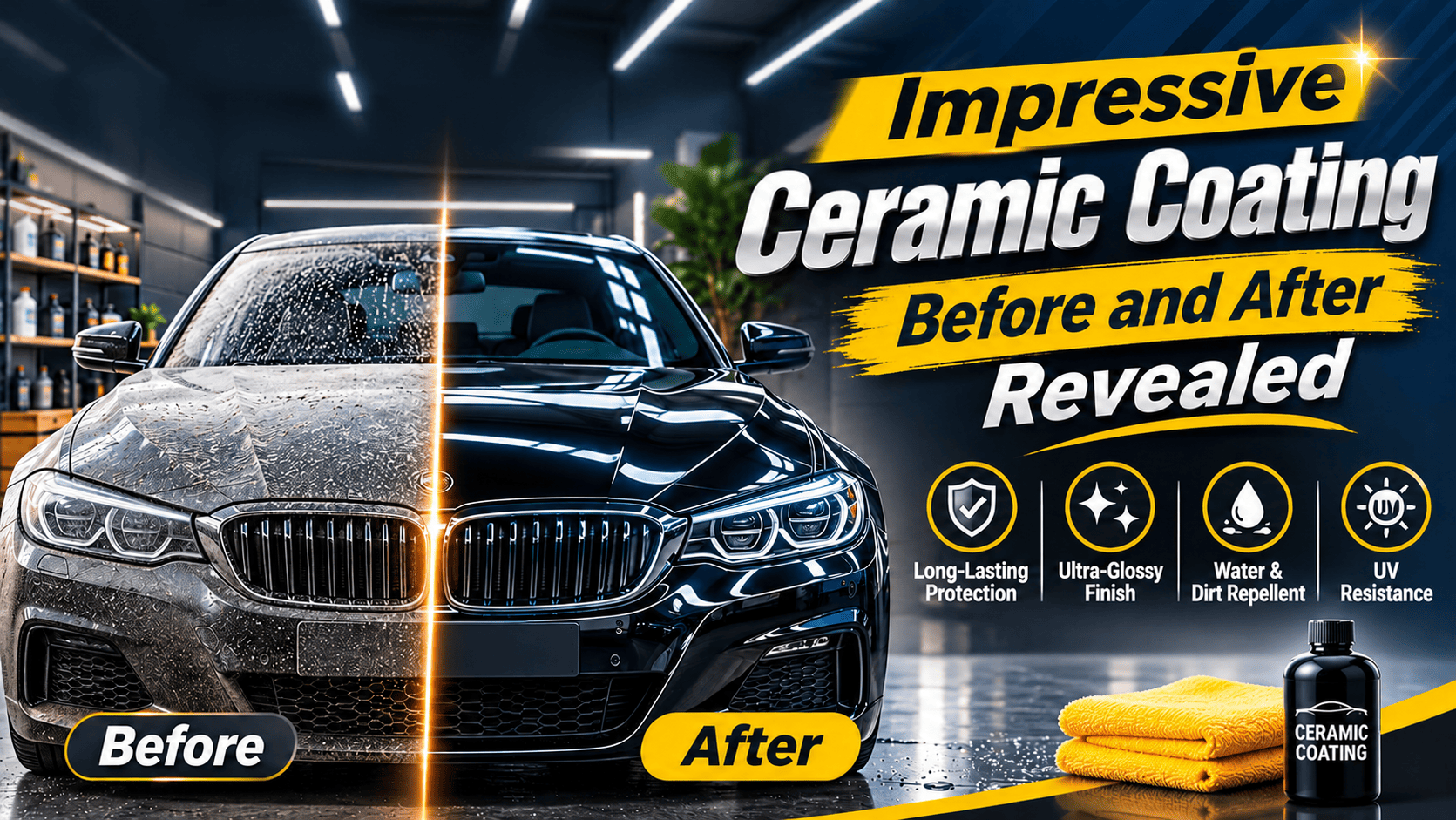
Ceramic coating can enhance your vehicle’s gloss, help repel water, and make routine cleaning easier, but it does not repair damaged paint. The most impressive ceramic coating before and after results usually combine careful cleaning, appropriate paint correction, and a properly applied protective coating. Understanding each step helps you judge the transformation—and set realistic expectations for your own car.
What changes can you expect before and after ceramic coating?
After ceramic coating, properly prepared paint can look richer and more reflective, while water beads more readily on the treated surface. However, the removal of visible swirls, haze, and fine scratches comes from polishing before application, not from the coating itself. A complete detailing service may deliver both improvements, which is why separating preparation from protection matters when comparing results.
Think of the transformation as two connected jobs: improving the existing finish, then helping preserve it. If a quote promises a dramatic makeover, ask which preparation steps are included rather than assuming the coating does everything.
| Area to evaluate | What may change | What to keep in mind |
|---|---|---|
| Gloss and reflections | Paint can appear deeper and clearer | Polishing may account for much of the improvement |
| Swirls and light scratches | Suitable defects may be reduced during correction | Coating alone does not remove them |
| Water behavior | Water beads and releases more readily | Beading does not prevent mineral deposits |
| Routine washing | Contamination may be easier to remove | Regular, careful washing remains necessary |
These distinctions are consistent with manufacturer guidance on coating capabilities, paint correction, and ongoing maintenance.
Preparation creates the foundation for a glossy finish
A coating needs a clean, properly prepared surface. CARPRO’s application guidance calls for cleaning and decontamination, optional polishing to address defects, and thorough surface degreasing before application. These are separate tasks with different purposes; applying protection over an inadequately prepared surface skips the foundation of the process.
Read Also This: Benefits Of Glass Coating Car Treatments
Cleaning and decontamination
Washing removes loose dirt, while decontamination addresses material that remains attached to the finish. The appropriate process depends on the paint’s condition and the coating manufacturer’s instructions. Before booking, ask whether the service includes inspection and targeted contamination removal rather than simply a wash followed by application.
Paint correction and surface preparation
Machine polishing can reduce suitable surface defects and improve clarity before protection is applied. It is a distinct service, so request a clear description of the correction included and the imperfections expected to remain. The goal should be an agreed, realistic improvement—not an unexplained promise of flawless paint.
This distinction matters when browsing car ceramic coating before and after photos. Ask whether the pictured vehicle received polishing, how extensive that work was, and whether the example represents the package you are considering. Otherwise, you may be comparing two very different services.
Coating benefits that matter beyond the first photo
A glossy finish attracts attention, but easier upkeep is an important part of the appeal. Ceramic coatings provide a protective surface with water-repellent properties and resistance to certain environmental contaminants. Those properties support maintenance; they do not replace it.
Water repellency and easier cleaning
Coatings can help water bead and make contamination less inclined to cling to the treated surface. In practice, that can make routine cleaning more manageable, especially when the vehicle receives consistent care. CARPRO nevertheless identifies regular washing as the most important maintenance task for its coatings.
Treat water behavior as one observation, not your entire quality test. Ask to inspect the clean, dry finish as well, and discuss how the installer recommends evaluating performance between maintenance visits.
An additional layer of paint protection
Ceramic coating adds protection against environmental and chemical exposure, but its resistance has limits. Bird droppings, road contamination, and other deposits still require attention rather than being left on the vehicle indefinitely. Think of paint protection as support for good care, not permission to stop caring for the finish.
For your own decision, consider which benefit matters most: appearance, easier washing, or maintaining a freshly corrected finish. That gives the installer a useful starting point and keeps the conversation focused on your priorities.
What ceramic coating cannot fix or prevent
Ceramic coating does not make paint scratch-proof, stop stone chips, or correct existing swirl marks. It also does not replace paint protection film where impact resistance is the main concern. These limitations belong in the conversation before application, not after the first disappointing scratch.
Water spots are another important boundary. A hydrophobic surface can still develop mineral deposits when water dries on it, and CARPRO specifically warns against allowing hard water to remain during maintenance. Attractive beading should never be interpreted as a guarantee of spot-free paint.
Likewise, a coated car can still suffer washing-related scratches. Gtechniq’s care guidance warns that unsuitable tools and techniques can introduce swirls, water spots, and other damage. Protection and washing technique need to work together if you want the finish to stay looking good.
How do you judge ceramic coating before and after photos fairly?
A fair comparison shows the same vehicle or panel under matching lighting, camera angles, and surface conditions, with the work performed clearly disclosed. Use photos to assess visible appearance, then ask separately about preparation, coating application, and maintenance. That approach avoids asking an image to prove more than it actually shows.
When reviewing before and after ceramic coating examples, use this checklist:
- Match the lighting: Request similar lighting in both images rather than comparing a shaded starting point with a carefully illuminated final shot.
- Match the angle: Look for the same panel and viewpoint so reflections are easier to compare.
- Inspect dry paint: Ask for a dry-finish image alongside any water-beading demonstration.
- Request close-ups: Examine the hood, doors, and other representative areas rather than relying only on a distant whole-car photograph.
- Identify the preparation: Confirm whether the result includes decontamination, polishing, or other work outside the coating package.
- Ask what remains: Request a straightforward explanation of visible defects that were not corrected.
For your own ceramic coating car before-and-after comparison, photograph several panels before the appointment. Repeat those views at collection, and keep the images with the written service description. This creates a useful reference without relying on memory or promotional photography.
Keep the result looking its best
Follow the instructions for the exact product applied to your vehicle. Initial water exposure, washing restrictions, and application requirements vary between coatings, so a universal curing timetable can be misleading. Get written aftercare guidance before taking the car home.
Once normal washing is permitted, build a straightforward routine:
- Remove loose dirt before contact washing. Pre-rinsing helps avoid dragging contamination across the finish.
- Use suitable wash products and clean tools. Follow the coating manufacturer’s recommendations rather than assuming every shampoo or accessory is compatible.
- Dry the vehicle carefully. Do not rely on water repellency to prevent deposits from water left to evaporate.
- Avoid abrasive brush washes. A coating does not eliminate the damage risk from unsuitable washing methods.
- Ask before adding treatments. Confirm that maintenance sprays, cleaners, and other products suit the installed coating.
These practices align with manufacturer guidance on preserving coated finishes and reducing washing-related damage.
If water behavior changes, ask for an assessment rather than immediately assuming the coating has failed. CARPRO notes that residue from unsuitable soaps can temporarily interfere with beading. Describe your washing products and recent exposure so the installer has useful information to investigate.
Choose the complete process, not just the shine
Before committing, request a written scope covering preparation, correction, coated surfaces, collection conditions, and aftercare. Ask which defects should improve and which will remain. If a durability claim or guarantee influences your choice, read its maintenance requirements and exclusions; Gtechniq’s published terms, for example, distinguish covered performance from damage, neglect, and inadequate preparation.
The most useful ceramic coating results are not simply the brightest photographs. They combine realistic expectations, clearly explained preparation, appropriate paint protection, and a care routine you can maintain. Start with a paint assessment and an itemized plan, then judge the finished vehicle against what was actually agreed.